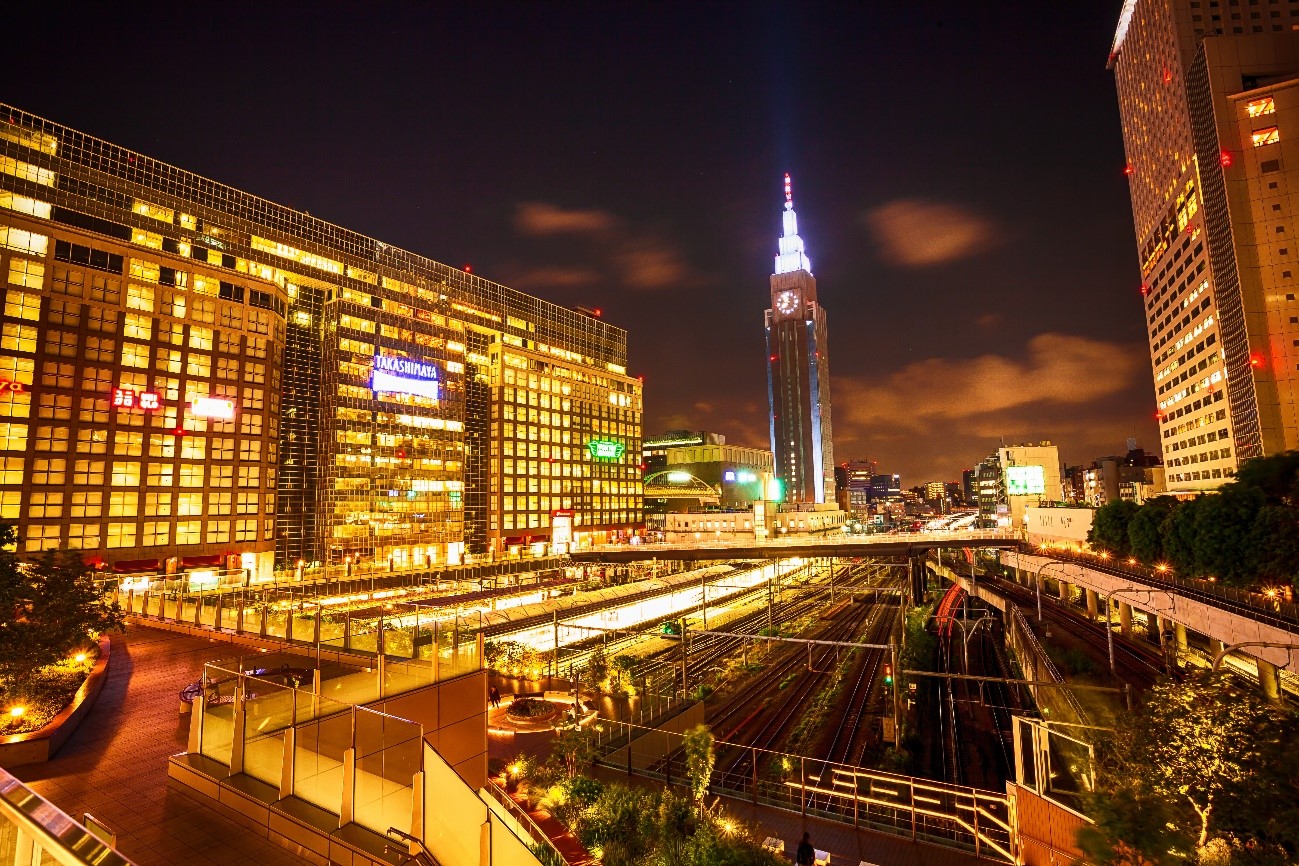
The Man Who Never Goes Straight Home
There is a figure so familiar in Tokyo that he has become, over decades, a kind of urban mythology: the salaryman who cannot go home.
He is easy to spot. He sits on the last train after midnight, suit jacket still buttoned, tie loosened by precisely one centimetre — the single concession to the hour. His eyes are closed, but he is not sleeping; the Japanese have a term, inemuri (居眠り), for this particular state of suspended consciousness, the ability to be present and absent simultaneously, to rest without ever fully letting go. He has spent fourteen hours in an office. Before that, he spent forty-five minutes on a crowded train getting there. Tomorrow, he will do the same. Tonight, however, he did not come directly from the office. He came, as he comes most nights, by way of somewhere else — a narrow izakaya three streets from the station, a karaoke box in a basement, a bar where someone knows his name and pours his drink without being asked.
He is not unusual. He is Japan.
Gaman: The Weight That Every Salaryman Carries
To understand why Tokyo's men take the long way home, it is necessary first to understand what they are carrying.
Gaman (我慢) is a Japanese concept that Western languages translate inadequately as "endurance" or "perseverance," but which carries something far heavier than either of those words suggests. Gaman is the cultivation of patience in the face of difficulty — the deliberate suppression of personal feeling in service of a larger obligation. It is considered not merely a practical virtue in Japanese culture but a moral one: the person who endures without complaint, who absorbs difficulty without transmitting it to others, is the person behaving correctly. The person who expresses frustration, who shows exhaustion, who allows the weight of the day to become visible to colleagues or superiors — that person is, in the Japanese moral vocabulary, behaving badly.
The kaisha (会社) — the company — is the institution around which this virtue organises itself. In the postwar decades that built modern Japan, the relationship between a man and his employer was understood in terms that had nothing to do with contract law. It was a relationship of loyalty, reciprocity, and identity. The company did not merely provide income; it provided structure, community, status, and purpose. In return, the employee gave not merely his working hours but his life — his evenings, his weekends, his health, his presence at every nomikai (飲み会) and every corporate ceremony, his willingness to remain at his desk until his superior had left, regardless of whether there was anything left to do.
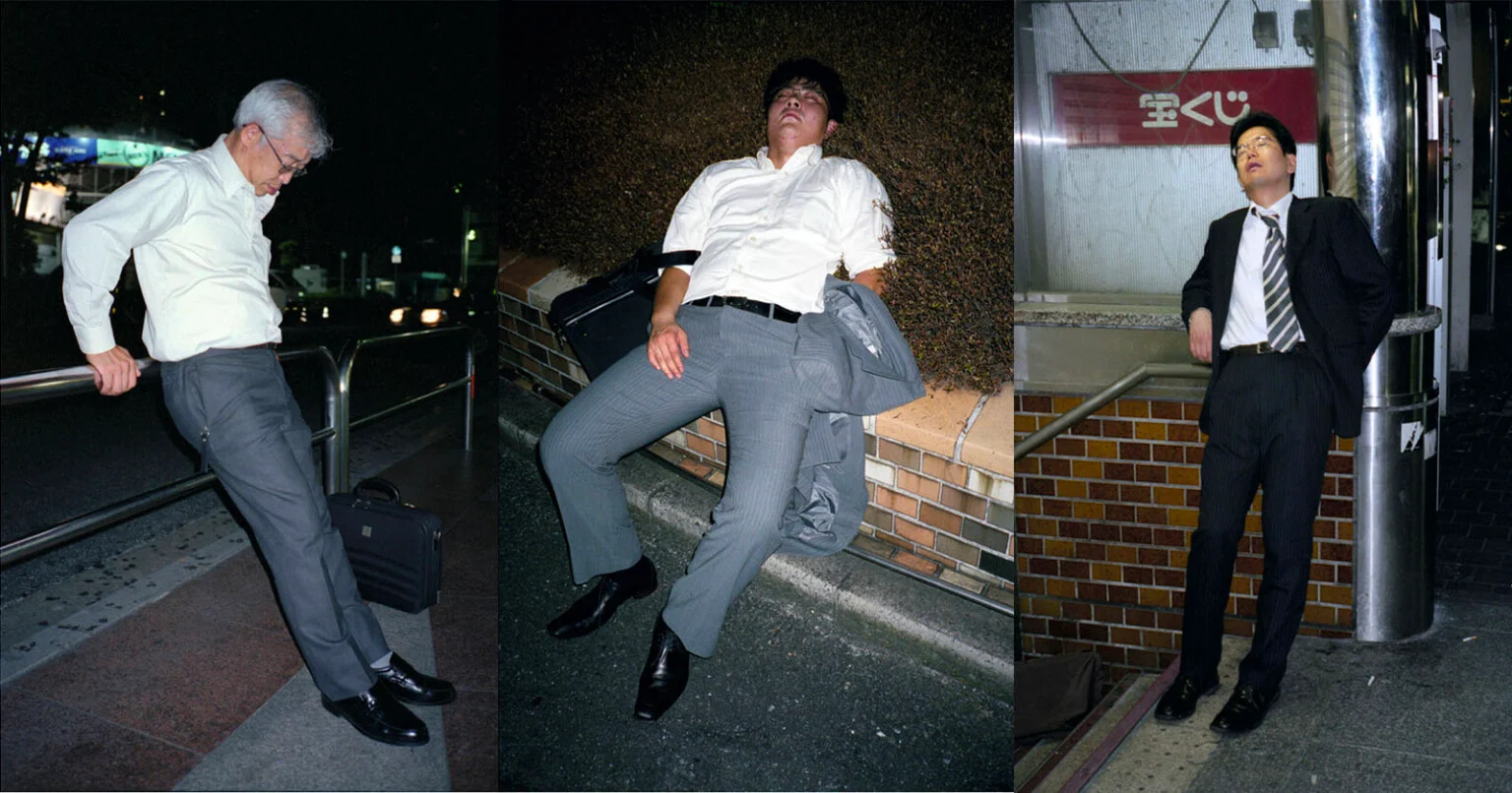
This arrangement produced, for several decades, one of the most productive economies in human history. It also produced, quietly and persistently, a very particular kind of suffering.
The Japanese government's most recent white paper on overwork recorded 1,304 recognised cases of overwork-related deaths and health disorders in a single fiscal year — the highest number since the government began tracking the phenomenon. More than 1,000 of those cases involved depression and other mental health disorders: also a record. Among Japanese men, 10.1 per cent work more than sixty hours a week. Among those working sixty hours or more, more than a quarter reported symptoms consistent with depression or anxiety.
These are the men who take the long way home.
Karoshi: When Dedication Becomes a Cause of Death
Japan gave the world a word that no other language needed until, slowly, every language began to need it.
Karoshi (過労死) means, literally, "death from overwork." The word entered the Japanese medical and legal vocabulary in the late 1970s, when researchers began to document a pattern that had been accumulating quietly for years: otherwise healthy men, most of them in their thirties and forties, dying suddenly of strokes and heart attacks that bore no obvious cause except the extraordinary and sustained pressure of their working lives. The first recognised case had been reported as early as 1969 — a 29-year-old worker in the shipping department of Japan's largest newspaper, dead of a stroke — but it took a decade and dozens of similar cases before the medical establishment was willing to assign them a common name.
The name, once given, changed something. It made visible what the culture had preferred to keep invisible: that the virtues Japan most prized in its workers — loyalty, endurance, self-abnegation — were, taken to their logical conclusion, lethal.

Karōjisatsu (過労自殺) — suicide from overwork — followed as a recognised companion category. The pathway from chronic overwork to depression to suicide was, by the 1990s, sufficiently well-documented that the courts began to recognise it as a form of occupational injury, making employers legally liable for the psychological deterioration of employees who had been driven past their limits. In fiscal 2024 alone, eighty-nine cases of work-related suicide or attempted suicide were formally recognised by the Japanese government — a figure that represents only those cases that met the precise legal threshold for official recognition, and therefore an almost certain undercount.
The pressure, it should be noted, is not only external. Gaman is not merely imposed from above; it is internalised, often completely, from childhood. Japanese men do not generally speak of being exhausted. They do not, as a rule, tell their colleagues that they are struggling. The culture that taught them to endure also taught them that admitting to difficulty is itself a form of weakness — which means that the men who are suffering most are, by training and disposition, the least likely to say so.
They are, however, often the most likely to stop for a drink on the way home.
Nomunication: The Art of Drinking Your Way to Honesty
The Japanese portmanteau nomunication (飲みニケーション) — formed from the verb nomu (to drink) and the English "communication" — is frequently introduced to Western readers as a charming cultural curiosity: a sign of Japan's unique relationship with workplace socialising. The reality it describes is considerably more serious than the wordplay suggests.
Japan's after-work drinking culture is not, at its core, about alcohol. It is about the temporary suspension of tatemae — the public mask — in a setting that the culture has agreed, tacitly but thoroughly, to treat as a kind of protected space. What happens at the nomikai stays at the nomikai. The things said over the second round of beer, the frustrations aired over the third, the moment of genuine laughter that breaks something open in a man who has been professionally composed for fourteen hours — these are permitted precisely because everyone present understands that they belong to a different register than the office. They are honne: real, true, unfiltered.
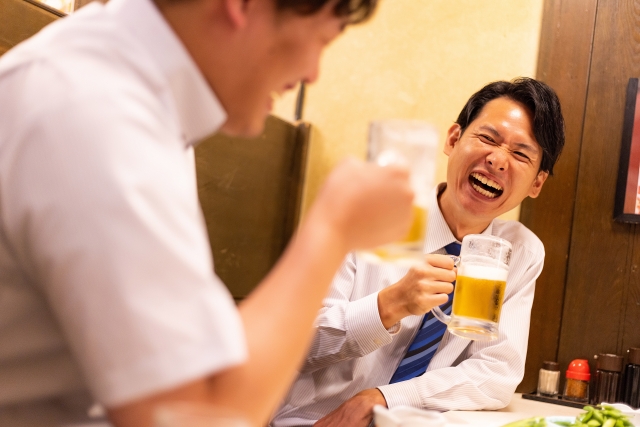
A typical evening follows a structure as formalised as any corporate meeting. The ichi-jikai (一次会) — the first party — begins at the izakaya: two hours of food, shared dishes, and beer, during which seniority asserts itself through the unspoken ritual of pouring for others before oneself. Then comes the ni-jikai (二次会), the second round, usually at a smaller bar or a karaoke box, where the loosening continues. Some evenings extend to a san-jikai (三次会): a third destination, by which point the hierarchies of the office have dissolved almost entirely, and the men around the table are — for the first time all day — simply people.

Recent surveys suggest that this culture is shifting, particularly among younger workers. Among employees in their twenties, 68.8 per cent report willingness to attend company drinking parties; among those in their fifties, the figure drops to 40.3 per cent — a reversal of what one might expect, suggesting that the generation that built the system has grown, perhaps, most tired of it. Yet even as attitudes change, the underlying need that nomunication was built to address does not disappear. The pressure does not diminish. And for the man who wants not a group but a presence, not collective release but individual recognition — Tokyo offers something else entirely.
The Stations Between Work and Home
Kabukicho, the district that sits at the eastern edge of Shinjuku and has served as Tokyo's great night city since the postwar reconstruction, is built around a very specific understanding of what men need after dark.
It is not, as outsiders frequently assume, built around excess. What Kabukicho is built around, with the quiet precision that Japan brings to every institution it takes seriously, is relief. The relief of a space that is neither the office nor the home. The relief of a conversation that carries no professional consequence and demands no domestic accountability. The relief of being listened to.

The hostess club (ホステスクラブ) is the most sophisticated instrument in this architecture of relief, and it is misunderstood by most people who have not experienced it. A hostess club is not a place where men go to be flattered by people paid to flatter them. It is a place where men go to be known. The distinction matters enormously. Flattery is a performance aimed at the ego. Being known is something that happens to the whole person — the tired person, the frustrated person, the person who has been professional and composed and utterly self-effacing for the entire length of a very long day.
A skilled hostess in Kabukicho does something that almost no one in a salaryman's daily life does: she pays complete, unhurried, genuine attention. She remembers the details he mentioned last time — the difficult colleague, the project that went sideways, the weekend trip that was cancelled for the third time because of work. She asks about them. She notices when the answer is different from what he expected to give. She creates, in a low-lit room with a glass of whisky and the right silence at the right moment, the experience of being a person rather than a function.
What the Night Gives Back
The salaryman who arrives at the last train after midnight is not, despite appearances, the same man who left the office. Something has shifted in the intervening hours — something small and necessary and very hard to name in any language.
He has not solved the problem of karoshi. He has not resolved the contradiction between the life Japanese corporate culture demands and the life a human being can sustain indefinitely. He has simply, for a few hours, been allowed to exist outside of it — to inhabit a version of himself that the office has no use for and the commute has no room for: the version that laughs, that confides, that notices the quality of a drink and the mood of an evening, that is present in the way that presence actually means something.
The West, observing this from the outside, has tended to diagnose it as dysfunction. The after-work drinking, the late-night bars, the hostess clubs — these are read, from a distance, as symptoms of a broken culture, evidence of men escaping from lives they cannot face. This reading, though understandable, gets the causality exactly backwards. The bars and the clubs and the long nights are not the problem. They are the response to the problem — a response that Japan's culture developed, over generations, with the same care and ingenuity it has brought to every other human difficulty it has decided to address seriously.
The problem is the pressure. The night is what absorbs it.
Related Articles


You may also like...


International Hostess Bar Since 1993
夢
ORIGIN
・ International Hostess Bar since 1993
・ Japanese Hospitality with International Service
・ Diverse and Charming Floor Ladies
・Located in Shinjuku, Tokyo
・Transparent Pricing
・Easy Online Reservations